
Yield in cooking refers to the total usable quantity of an ingredient or recipe after preparation and cooking — measured in weight, volume, or portion count. It answers a deceptively simple question: how much of what you bought can you actually use?
That gap between what you pay for and what lands on the plate is where restaurant margins live or die. Misunderstanding yield leads to underpriced menus, inaccurate food costs, and money left on the table every single service.
This guide covers everything: what yield means, how to calculate it, the different types, and how professional kitchens use yield data to run tighter, more profitable operations.
What Is Yield in Cooking?
Yield in cooking is the amount of usable product remaining after an ingredient has been trimmed, cleaned, prepped, or cooked. It accounts for the weight lost during peeling, deboning, portioning, and cooking shrinkage.
For example: if you start with 5 lbs of carrots and end up with 4 lbs after peeling and trimming, your yield is 80%. That's the yield - the usable amount after processing. You lost 1 lb — and you already paid for it.
Yield applies at every stage of kitchen production:
- Butchering meat — fat, bones, and sinew removed before portioning
- Breaking down produce — peels, seeds, and stems discarded
- Cooking — moisture loss from roasting, grilling, or braising shrinks weight further
- Portioning — every portion cut from a larger piece must account for total yield
Understanding yield isn't just culinary knowledge — it's financial knowledge. The cost of that lost 20% of carrots doesn't disappear. It shows up in your food cost whether you account for it or not.
Raw Yield vs. Edible Yield: What's the Difference?
Raw Yield (As Purchased / AP Weight) is the weight of an ingredient exactly as it arrives from your supplier — before any processing. This is what you're invoiced for.
Edible Yield (Edible Portion / EP Weight) is the usable amount remaining after trimming, cleaning, portioning, and/or cooking.

The gap between AP and EP is where most kitchens underestimate their true ingredient costs.
How to Calculate Yield Percentage
The yield percentage formula is: Yield % = (EP Weight ÷ AP Weight) × 100
Example — Butternut Squash:
- AP weight: 3.1 lbs at $1.64/lb
- Waste (peels, seeds, trim): 0.49 lbs
- EP weight: 2.61 lbs
- Yield %: (2.61 ÷ 3.1) × 100 = 84%
Translating Yield % into Real Cost: The Cost Factor
Cost Factor = 100 ÷ Yield % | EP Cost = AP Cost × Cost Factor
Example — Beef Tenderloin:
- AP cost: $21.00/lb, Yield: 70%
- Cost factor: 100 ÷ 70 = 1.43
- EP cost: $21.00 × 1.43 = $30.03/lb
That's the real cost of the beef you're serving. Build recipes and menu prices on EP cost — not AP cost.
Types of Yield in Cooking
1. AP (As Purchased) Yield
The total weight and cost of an ingredient before any processing. This is your baseline — the number on the invoice — but rarely the number that matters for costing.
2. EP (Edible Portion) Yield
The usable weight after trimming, cleaning, and removing inedible parts. This is what you should cost recipes against. A chicken that costs $1.65/lb AP but yields 72% edible meat has an EP cost of $2.29/lb.
3. Cooking Loss Yield
Ingredients shrink during cooking due to moisture evaporation and fat rendering. A 250g steak can drop to 200g after grilling. Cooking loss yield must be factored in for dishes where the ingredient is cooked before portioning.
4. Trimming Yield
The reduction in usable product from cutting away inedible portions — fat caps, sinew, bones, skins. Tracking trim yield by cook and by supplier reveals efficiency and quality gaps across your operation.
How to Run a Yield Test
A yield test establishes standard yield percentages for any ingredient. Follow these steps:
- Step 1: Weigh the raw ingredient (AP weight) — full weight as purchased
- Step 2: Prep the ingredient using your standard kitchen method
- Step 3: Weigh the waste — all trimmings, peels, bones discarded
- Step 4: Calculate EP Weight = AP Weight − Waste Weight
- Step 5: Calculate Yield % = (EP ÷ AP) × 100
- Step 6: Calculate EP Cost = AP Cost × (100 ÷ Yield %)
Example: Pork Butt Yield Test
- AP weight: 8.8 lbs at $2.38/lb (total: $20.94)
- Trim and fat removed: 2.1 lbs
- EP weight: 6.7 lbs → Yield: 76%
- EP cost: $2.38 × 1.32 = $3.14/lb
- Per-portion cost at 0.44 lbs/serving: $3.14 × 0.44 = $1.38/portion
Run yield tests on at least 3–5 samples of the same ingredient to establish a reliable average. Individual pieces vary — a single test can be misleading.
Why Yield Testing Matters for Restaurant Operations
1. Accurate Recipe Costing
If your recipes are costed at AP prices, your food cost calculations are wrong. EP-based costing gives you the real cost of every dish and reliable data for menu pricing decisions.
2. Supplier Evaluation
Run yield tests on product from different suppliers. A supplier charging $0.10/lb less but delivering at 65% yield instead of 72% is actually more expensive when you do the math.
3. Cook Efficiency Benchmarking
If one cook consistently yields 5% less than another on the same cut, that's a training issue — and a food cost issue.
4. Smarter Ordering
Back-calculate how much AP product you need for a specific EP quantity: AP Needed = EP Required ÷ Yield %. Example: 10 lbs trimmed beef at 70% yield requires ordering 14.3 lbs AP.
5. Portion Consistency
When every cook works from standard yield data and standardized portion sizes, every plate is consistent — protecting both food cost and the guest experience.
6. Waste Reduction
Yield data reveals where losses occur and whether trimmings can be repurposed for stocks, sauces, or staff meals.
Frequently Asked Questions About Yield in Cooking
1. What is yield in cooking?
Yield in cooking is the usable quantity of an ingredient or recipe after preparation and cooking — the portion that can actually be served to a guest, expressed in weight, volume, or number of portions.
2. How do you calculate yield percentage?
Yield percentage = (EP Weight ÷ AP Weight) × 100. For example, if 5 lbs of carrots yield 4 lbs after peeling, the yield is (4 ÷ 5) × 100 = 80%.
3. What is the difference between AP cost and EP cost?
AP cost is what you pay per pound as delivered. EP cost is the true cost per usable pound after accounting for trim, waste, and processing loss. EP cost is always higher than AP cost, and it's the number your recipes should be costed against.
4. How does cooking loss affect yield?
Cooking methods — grilling, roasting, braising — reduce ingredient weight through moisture evaporation and fat rendering. A protein that yields 70% after butchering may lose an additional 15–20% during cooking, meaning your final portion cost is significantly higher than your trimmed EP cost suggests.
5. Why do yield percentages vary between suppliers?
Differences in fat content, moisture levels, trimming standards, and product quality all cause yield variation across suppliers. Running yield tests on product from each supplier reveals which delivers the best true value — regardless of invoice price.
6. How does yield affect menu pricing?
Every dollar of yield loss is a real cost that must be recovered through menu pricing. Recipes costed at AP price without yield adjustments consistently understate food cost and lead to underpriced menus. Accurate EP costing ensures your menu prices protect your margins.
7. What ingredients need yield testing most?
High-cost, high-waste ingredients benefit most: beef, pork, poultry, and seafood; whole fish; fresh produce like butternut squash, fennel, artichokes, and whole heads of garlic; and any ingredient processed in large batches where small percentage differences translate to meaningful dollar amounts.
8. How many samples should I use for a yield test?
Run yield tests on at least 3–5 samples of the same ingredient and average the results. Individual pieces vary naturally — a single test may not represent your true standard yield.
Skip the Manual Calculations — meez Handles Yield Automatically
Running manual yield tests and updating spreadsheets every time an ingredient cost changes is time-consuming and error-prone. Most kitchens don't do it consistently — which means their food costs are wrong.
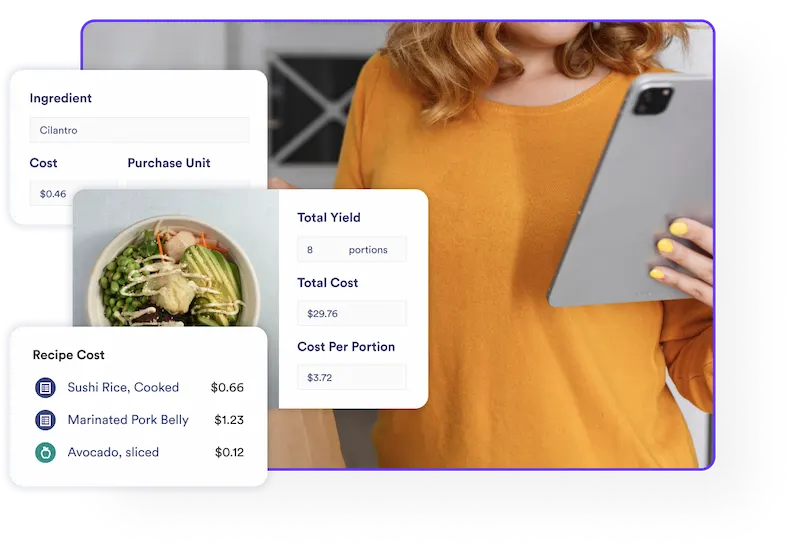
meez is built differently. Our ingredient database includes built-in yield and prep loss data for 2,500+ ingredients, calculated from years of culinary research and real kitchen testing.
When you build recipes in meez:
- Yield adjustments are automatic. Every ingredient is costed at its true EP cost — not AP — without any manual calculation.
- Costs update in real time. When invoice prices change, every recipe that uses that ingredient recalculates instantly.
- Scaling stays accurate. Scale a recipe up or down and yield-adjusted costs recalculate automatically.
- Supplier comparison is built in. See how yield differences across suppliers affect your true cost per usable unit.
The result: accurate food costs, profitable menu pricing, and more time for your team to focus on cooking. Take a 2-minute interactive tour of meez →